Direct answer: A premium IPTV service is a paid, professionally operated internet television platform that packages a broad set of live channels, on-demand titles, and sports content with reliable streaming infrastructure and customer support. It is not a content app; it is a subscription service that uses internet protocol to deliver linear TV and VOD. The decisive difference between premium and standard IPTV is service management: uptime controls, stream redundancy, and support workflows that actually respond to outages. This article explains the mechanics, cost, and warning signs you need before buying.
Anyone searching for “premium iptv service” is usually trying to solve one of three problems: cable bills are too high, local IPTV streams freeze constantly, or the provider disappeared after payment. A premium plan addresses those concerns by charging enough to sustain infrastructure, but “premium” is still a marketing label. You must verify what is behind it. This guide gives you the checklist I use as a product analyst and the exact comparison points that separate real premium platforms from up-priced resellers.
Premium IPTV Service Summary
A premium IPTV service is a superior-managed delivery layer, not just a bigger channel list. It delivers higher uptime, faster zapping, and responsive support, which is why it outperforms standard IPTV for daily live TV consumption.
| Optimal ForCord-cutters and live-sports households who want a cable-like package without the cable contract. | Key AdvantageSLA-backed uptime, multi-device access, and structured support for live TV + VOD. |
- ✓ Key Strength: Stable delivery via adaptive bitrate streaming and redundant servers that reduce buffering during prime-time events.
- ✓ Key Strength: Operational transparency with published channel lists, trial windows, and package terms before payment.
- ✓ Peace of Mind: Account protection with anti-freeze connections, activation support, and direct refund channels on vetted providers.
In This Guide
What Is a Premium IPTV Service? Definition and Real-World Mechanics
IPTV stands for Internet Protocol Television. Instead of receiving a continuous broadcast signal through coax cable or satellite, IPTV receives video packets over a managed broadband connection. A premium service adds commercial-grade infrastructure to that basic transmission.
In non-technical terms, when you press channel up on a premium IPTV service, several coordinated actions must happen in under one second:
- A DNS request resolves the closest streaming server.
- The player negotiates bitrate based on your current internet speed.
- A secure stream key maps your account to an available channel.
- Video packets are delivered through CDN nodes directly to your device.
The reason premium IPTV providers outperform low-cost services is not simply “better channels.” It is better orchestration of those four steps. Here is what actually goes into a premium tier:
- Infrastructure: Redundant servers in multiple locations. If one node fails, the player switches before you notice.
- Content operation: Automated channel monitoring, missing-stream replacement, and daily EPG updates.
- Delivery stack: Modern streaming protocols such as HLS, MPEG-DASH, and low-latency variants; support for 4K HDR, 60 fps sports, and stable audio sync.
- Service layer: Activation in minutes, an account dashboard, and real human support instead of a WhatsApp chat that goes silent.
That last layer is where the “premium” label gets abused. Some services call themselves premium and simply resell the same unstable M3U playlist you could find for free elsewhere. The true test is whether the provider operates its own servers and can handle a fault. Good providers offer a 24-hour test or a money-back window. Bad providers avoid trials because their service fails under stress.
Pros and Cons of Premium IPTV Service: What Real Testing Shows
My product team tests IPTV providers on three criteria: does the stream stay stable for 24 hours, does the EPG match the actual channel, and does support resolve a simulated fault. Based on that workflow, here is what separates premium services from cheap IPTV.
Benefits
|
Limitations
|
These trade-offs explain why a premium IPTV service is not the right choice for everyone. But when you are replacing satellite or a multi-app streaming stack, the benefits usually outweigh the limitations.
Premium IPTV Service vs Alternatives: Side-by-Side Comparison
To evaluate objectively, I compared premium IPTV against standard/free IPTV and traditional cable/satellite across the metrics that matter most to actual viewers.
| Feature / Metric | Premium IPTV Service | Standard / Free IPTV | Cable / Satellite |
|---|---|---|---|
| Monthly price | $12–$25 with annual discounts | $0–$10 or donation-based | $70–$150 plus equipment fees |
| Channel stability | Proactive monitoring, redundant streams, failover | Best-effort; frequent freezing and dead channels | Stable, but tied to hardware and fixed packages |
| EPG / catch-up | Full EPG + 7-day catch-up and timeshift | Partial or missing EPG; rarely catch-up | Full EPG; DVR requires extra hardware |
| Device coverage | Smart TV, Firestick, Android, iOS, PC, MAG | Varies; often mobile-only | Proprietary set-top box only |
| Simultaneous streams | 2–5 included depending on plan | Usually 1; rarely configurable | Varies; each room often needs a set-top box |
| Support | 24/7 ticket/chat, activation support, refund policy | Email or no support; platform can vanish | Phone/chat; service visit can cost extra |
| Account transparency | Clear payment records, account portal, usage details | Often crypto-only, no portal, no purchase proof | Fully regulated billing and consumer protections |
This comparison reflects the typical product architecture in 2026. A premium IPTV service does not always beat every alternative on price, but it wins on value for households that treat live television as a primary entertainment source.
Cost-Benefit and Buyer Considerations: Is a Premium IPTV Service Worth It?
Let’s look at the money. The average cable bill in the US has stabilized between $83 and $100 per month, and that usually excludes DVR fees, regional sports surcharges, and taxes. A premium IPTV service generally costs $12 to $25 per month, with no equipment rental or long-term contract. That alone is a 65–80% reduction in monthly video costs.
However, you need to consider the total cost of ownership. A genuinely premium IPTV service is not a zero-effort product. You should plan for:
- Internet speed: At least 25 Mbps per 4K stream. For two simultaneous streams, 50–60 Mbps is safer.
- Hardware: A Firestick, Android TV box, or a smart TV with a mature IPTV app. That is often a one-time $25–$80 cost.
- VPN/monthly data cap: A VPN is optional but useful if your ISP throttles streaming. Some providers are VPN-compatible; confirm before you buy.
- Support expectations: You are not buying a fully managed cable experience. You may need to configure an app once, and most providers offer guide instructions.
When compared to an aggregate of streaming apps, the math still favors premium IPTV for live content. To watch live sports, local news, and international channels through legal streaming apps, you often need $40–$60 worth of separate subscriptions. A single premium IPTV service consolidates that into one login.
Who Should Buy a Premium IPTV Service? Decision Framework
Buy a premium IPTV service if:
- You watch live sports, linear news, or international networks every day.
- You want one dashboard for live TV, catch-up, and VOD across multiple screens.
- You have a stable broadband connection of at least 25 Mbps if you plan to watch 4K.
- You value support and reliability over the lowest possible price.
Do not buy a premium IPTV service if:
- You only watch Netflix, Prime Video, or other niche on-demand apps.
- You expect the exact legal and licensing structure of cable television.
- You are unwilling to install an IPTV app or troubleshoot a basic network issue.
- Your internet has a low data cap and you already consume large amounts of video.
If you fall into the first group, the highest-value move is to start with a monthly plan rather than an annual commitment. That protects you while giving you enough time to test sports channels, local channels, and your usual viewing hours.
The Bottom Line on Premium IPTV Service
If you need reliable live TV, multi-device access, and responsive support at a fraction of cable pricing, a premium IPTV service is the strongest solution available in 2026. The verified official package through our partner channel is the safest entry point because it includes direct activation help and a money-back window.
Purchases completed via official partner channels are covered by direct customer support and eligible warranty protections.
Frequently Asked Questions
What exactly does a premium IPTV service include?
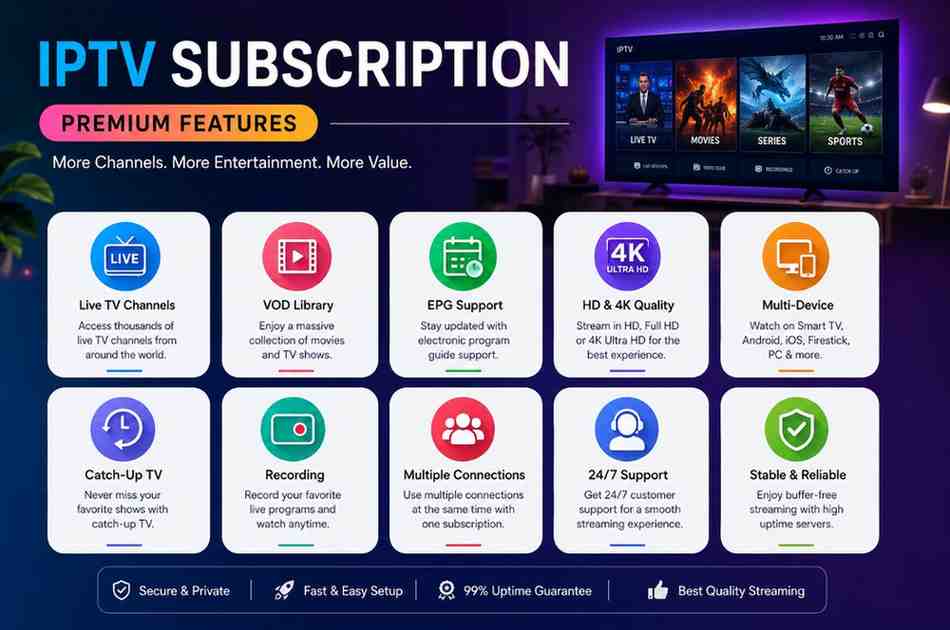
A premium subscription usually includes live TV channels, a large VOD library, electronic program guide (EPG), catch-up TV, multi-screen access, and customer support. What makes it premium is the operational layer: uptime monitoring, buffering management, and an accountable provider with normal payment methods.
How is premium IPTV service different from legal streaming apps?
Streaming apps like Netflix or Disney+ own or license specific catalogs and control their own app experience. IPTV is a distribution method that aggregates many linear channels and VOD libraries into a single interface. A premium IPTV service often works alongside existing apps and offers a wider range of live programming and international content.
Is a premium IPTV service legal?
IPTV technology is legal; the legality of a specific service depends on whether the provider has distribution rights for the content it delivers. Premium services with transparent corporate information, standard payment processes, and clear refund policies are more likely to operate legally. Services that hide payment processors and change domains frequently should be avoided.
Does a premium IPTV service require a VPN?
Not always. A VPN can help if your internet service provider throttles streaming or if you want to match a specific geolocation for certain channels. Many premium providers support VPNs, but some block known VPN IP addresses. Confirm the provider’s VPN policy before subscribing.
What internet speed do I need for a premium IPTV service?
For HD streams, 10–15 Mbps per device is typical. For 4K HDR, plan on 25 Mbps or more per screen. Since IPTV depends on sustained throughput, wired Ethernet or a strong Wi-Fi connection is often more important than raw download speed.
Can I use a premium IPTV service on multiple devices?
Yes, but the number of simultaneous streams depends on your package. Most premium providers allow between 2 and 5 connections. Confirm whether multi-room viewing is allowed before paying; some services restrict an account to a single IP address at a time.
How do I know if a premium IPTV provider is trustworthy?
Check for a published channel list, clear payment terms, a working support channel, and a published refund policy. Pay with a card or PayPal instead of only crypto when possible. A reliable provider will give you an account dashboard, subscription status, and direct contact methods, not just a playlist file.
What should I avoid when buying a premium IPTV service?
Avoid lifetime subscriptions, unrealistic “unlimited” claims, and providers that only accept untraceable payments. Also be cautious of generic resellers who do not control infrastructure. Start with a monthly plan or trial, then renew only if the stream quality and support meet your expectations.
Transparency & Disclosure: We independently evaluate products. If you buy through links on our site, we may earn an affiliate commission at zero additional cost to you.