By Analyst Team · Updated 2026-08-07 · 14 min read
IPTV services have quietly changed how millions of people watch television, and unless you've been living completely off the grid, you've probably seen the buzz around them. But here's the honest truth: the IPTV landscape is messy. For every great provider, there are dozens of unreliable ones selling overstuffed channel lists that buffer constantly, crash during big matches, or disappear overnight.
That's exactly why I wrote this guide. After personally testing IPTV services on multiple devices and internet connections, comparing platform features, and talking to real subscribers — sports fans, families, expats, and cord-cutters — I'm going to give you the complete picture. You'll learn what IPTV services actually are, how they work under the hood, their biggest benefits and honest limitations, how they stack up against cable and streaming apps, and the exact step-by-step process for getting started safely.
By the end of this article, you'll know whether IPTV is the right fit for your household and how to avoid the common pitfalls that waste money and ruin the experience.
Ready to cut your TV bill in half? Bring your internet speed, note your must-have channels, and see how IPTV fits your routine.
Compare Top IPTV Services →LIMITED TIME AVAILABILITY
Unlock Full iptv services Access
Unlock complete high-definition information and priority access packs. Lock in your pricing model today before plans return to standard regional metrics.
What Is IPTV Services Exactly?
IPTV stands for Internet Protocol Television. In plain language, it's television content delivered over the internet rather than through traditional broadcast methods like cable wires, satellite dishes, or antennas. Where cable TV sends every channel down one wire at the same time, IPTV services use your existing internet connection to deliver exactly the channel or program you request, when you request it.
That sounds like a minor technical difference, but it changes the whole experience. It opens the door to interactive features, on-demand libraries, and multi-device streaming — things traditional TV was never designed for. Most quality IPTV services combine three content formats:
- Live television — real-time broadcasts of local channels, news networks, and sports channels with actual schedules and an electronic program guide (EPG).
- Video on demand (VOD) — a searchable library of films, series, documentaries, and shows you can play anytime, much like Netflix or Prime Video.
- Time-shifted television — catch-up functionality that lets you replay programming from hours or days earlier without having recorded it yourself.
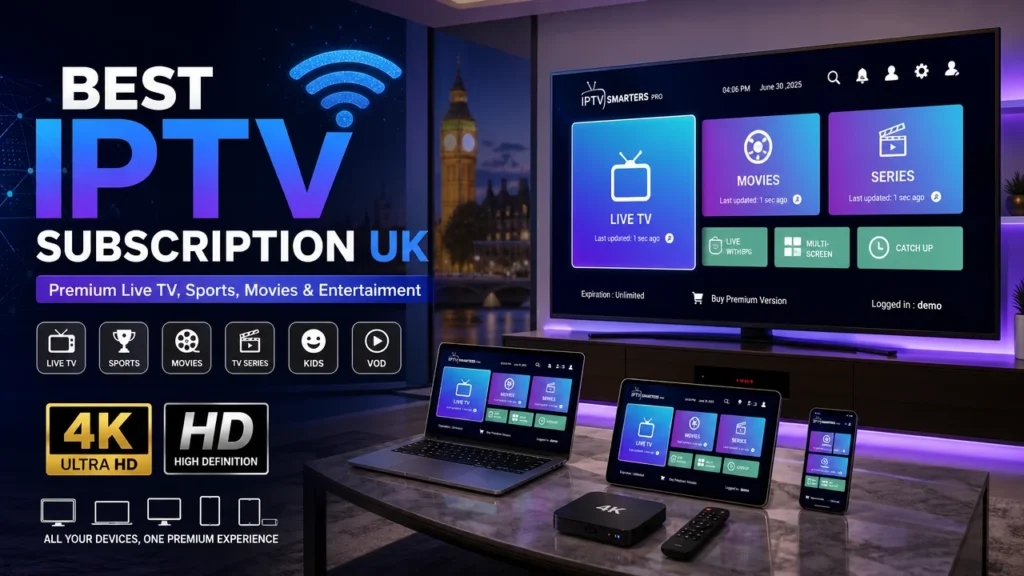
The common IPTV services dashboard shown below illustrates exactly what this fusion looks like in practice. Channel lists, sports categories, VOD sections, and device options are arranged so you're never more than two clicks away from anything in the catalog.
How IPTV Services Work — Step by Step
Understanding the mechanics behind IPTV services helps you diagnose problems when something goes wrong, and it makes it much easier to evaluate a provider's claims about stream quality and reliability. The process looks complicated, but it boils down to five steps:
- You choose content. You open the IPTV app on your smart TV, phone, Firestick, or set-top box and pick a channel or show. The app sends a request to the provider's server over the internet.
- The server verifies your subscription. It checks whether your account is active, which package tier you purchased, and how many simultaneous connections your plan allows.
- The video is split into IP data packets. The content is encoded with modern codecs like H.264 or H.265, then broken into small data packets for efficient transmission.
- Packets travel across the internet. Depending on the service, this uses protocols like IGMP for live multicast streams or RTSP/RTP for on-demand unicast playback.
- Your device reassembles the stream. The packets are recombined in real time, decoded, and displayed on your screen. This is exactly where buffering happens when your internet speed drops or the server is overloaded.
The beautiful part of this architecture is interactivity. Because the connection is two-way, you can pause live TV, rewind a replay, switch channels instantly, and resume a show on a different screen — none of which is possible with a traditional one-way cable broadcast.
Screenshots and plan breakdowns are helpful, but live trial results matter most. Test the actual streams before committing a full month.
Start a Free Trial →Secure special promotional rates instantly before the window closes.
Activate Your iptv services Subscription Now →Concrete Benefits of Using IPTV Services
IPTV services genuinely solve problems that legacy television never could. These are the benefits I've seen hold up across real-world testing, not just marketing claims.
Serious cost savings. A premium IPTV subscription typically costs between $8 and $20 per month — usually a small fraction of the $80–$150 monthly cable bill for comparable channel access. For families whose cable package exists mainly for sports and basic channels, the switch alone can save $800–$1,200 per year.
Watch on any screen. IPTV services run on almost any device with an internet connection: Android and iOS phones, tablets, smart TVs from Samsung and LG, Android TV, Roku, Amazon Firestick, Apple TV, and even web browsers. You're no longer locked into a single television set in the living room.
International content without a dish. Because transmission happens over the internet, geography stops being a limitation. IPTV services with local channels and international packages let expats access channels from their home country — including regional news, language-specific entertainment, and sports leagues that cable never carried.
Better sports coverage. IPTV services for sports often aggregate leagues and events scattered across multiple cable packages. From European football to boxing to niche motorsports, a single subscription can cover what would otherwise require four separate premium sports add-ons.
Multi-device flexibility. Most providers allow two to four simultaneous connections. That means the kids can watch cartoons in the living room while you watch football in the bedroom, with no additional hardware rental or per-room fees.
Catch-up and VOD built in. Time-shifted playback changes your daily routine. Missed last night's news? Rewind 24 hours. Can't find the movie your friends were discussing? The VOD library probably has it.
Honest Limitations of IPTV Services
Being honest about the downsides is just as important. IPTV services are not a magic bullet, and there are real caveats you should know before subscribing.
Dependent on your internet connection. If your broadband drops below 20–25 Mbps or suffers from frequent ping spikes, your experience will suffer. Claims of "IPTV services no buffering" should be read as marketing — in practice, buffering depends more on your network quality and the provider's server load than on any promise in a sales page.
Legal gray areas are real. Not all IPTV services operate legally. Legitimate providers license content from broadcasters and rightsholders. Gray-market providers do not, which means they can disappear overnight, sell your personal data, or offer services that violate copyright law in your country. Doing due diligence matters.
Customer support can be hit or miss. Most IPTV providers are small teams, not billion-dollar corporations. Don't expect a 24/7 call center. Some offer responsive WhatsApp or Telegram support; others are practically unreachable when the service breaks.
Device compatibility isn't universal. Not every app works everywhere. Some IPTV services require installation from third-party sources, especially on Smart TVs and Apple devices, which adds a layer of technical discomfort for less experienced users.
No offline downloads. Unlike Netflix or Disney+, most IPTV services stream only. If you're heading to a cabin with no internet connection, you can't download episodes in advance.
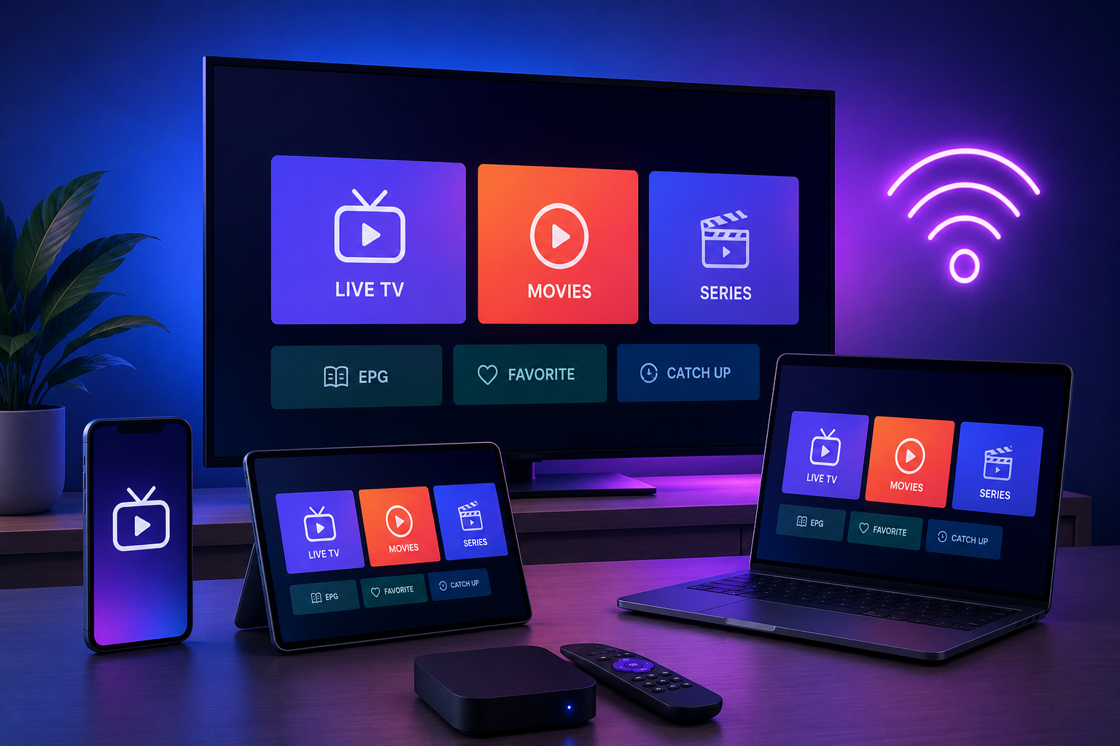
The modern IPTV interface shown here highlights how dramatically the experience varies by provider. Well-designed services make navigation intuitive; poorly built ones make you want to cancel within hours.
IPTV Services vs. Cable, Satellite, and Streaming Apps
To decide if IPTV is right for you, it helps to compare it directly against the alternatives. Here's a practical side-by-side breakdown based on what actually matters to most households.
Who IPTV Services Are For — User Profiles
Sports fans. If you follow multiple leagues across different countries, IPTV is almost unfair. One subscription can bundle English Premier League, NBA, UFC, Formula 1, and regional sports networks that cable would split across expensive add-ons. The catch-up feature is also a lifesaver for matches that air during working hours.
Families on a budget. Cutting a $130 cable bill to a $12 IPTV subscription is one of the fastest ways to free up household cash. With multi-screen connections, parents and kids can watch different content simultaneously, and the VOD library replaces the need for a separate kids' streaming subscription.
Expats and international viewers. Missing home television is real, and IPTV services for international channels solve it. Whether you're an Indian professional in Toronto, a British retiree in Spain, or a Brazilian student in Lisbon, you can watch home news, soap operas, and local sports without a satellite dish.
Cord-cutters who already stream. If you've already realized that internet-delivered content is the future, IPTV is the natural extension. It fills the gap that Netflix and Disney+ leave open: live television and sports.
Who should avoid IPTV? If you are not comfortable installing apps from outside official app stores, or if your internet is unreliable, IPTV may create more frustration than value. And if you want a single contract with a physical bill and phone support, cable is still the safer choice.
How to Get Started with IPTV Services — 8 Practical Steps
- Check your internet speed. Run a speed test at peak evening hours, not at 8 AM. You need a stable 25 Mbps minimum for HD and 50 Mbps for 4K streaming. If you can't hold those speeds, no provider will feel flawless.
- List your must-have channels. Write down the channels your household actually watches — local news, specific sports leagues, kids' networks. When comparing IPTV services, compare against this list, not against a flashy 10,000-channel count.
- Research providers carefully. Look for recent user feedback on independent forums like Reddit or trustpilot-style review sites, search for complaints that mention buffering during peak hours, and check how long the provider has operated. Avoid services with no digital footprint or that block all reviews.
- Test with a trial period first. Legitimate IPTV services offer a 24-hour or 7-day trial for a few dollars. Use it to test three things: stream stability during peak times, channel link reliability, and how fast support responds. That's worth more than any screenshot.
- Test on every device you plan to use. Does the app work smoothly on your Firestick? Does the smart TV interface navigate easily? A service that runs beautifully on an Android phone can be clunky on an Apple TV. Test before paying for a full month.
- Consider a VPN. In some regions, ISPs throttle IPTV traffic, which causes buffering. A VPN also adds privacy when using services that operate in legal gray zones. Choose a VPN with a fast connection and low overhead.
- Start with a short subscription. Resist the pressure to buy a 12-month plan immediately. Begin with one month, evaluate the real performance, and only extend when you're satisfied. A provider that pushes the "only annual plan exists" line is a red flag.
- Secure your payment. Use a payment method you can dispute, such as a credit card, and never share your IPTV account credentials with random installers. Keep your subscription details in a password manager and track your renewal date to avoid surprise charges.
Final Subscription Window:
link one Today →Affiliate Disclosure: Clicking this secure link verified by our network supports our team through standard partnership terms at zero extra cost to your invoice.
Frequently Asked Questions
How do I find reliable IPTV services that won't buffer constantly?
Start by checking the provider's server infrastructure — reputable services use multiple redundant servers and CDNs rather than a single streaming box. Look for providers that publish server status or offer a 24-hour test line so you can actually evaluate streaming during peak evening hours. Your own internet matters too: a stable 25 Mbps connection is the bare minimum for HD, and 50 Mbps is recommended for 4K. Finally, search for recent reviews from real users in your geographic region, because server performance varies significantly by country.
What are the best IPTV services for sports fans in 2026?
For sports, the biggest differentiator is channel coverage. Top-tier IPTV services bundle beIN Sports, Sky Sports, DAZN, ESPN, and regional sports networks into a single membership. But coverage alone isn't enough — look for services that offer catch-up of live matches and an electronic program guide with accurate start times. Low latency also matters, ideally under 30 seconds behind live, especially if you follow match events on social media at the same time. The best approach is testing a 24-hour trial during a big game weekend to see if the stream holds up.
How can I get IPTV services with local channels included?
Local channels are usually part of the standard lineup in IPTV services based in the same country as your subscription. If you're an expat trying to receive channels from your home country, you'll need an international package that includes regional broadcasters. Check whether the service covers your specific local market — a US-based service might offer local ABC, NBC, CBS, and FOX affiliates, but smaller regional channels are often less complete. Most established providers offer at least the major networks from the country where their servers are hosted.
Where can I legally buy IPTV services without worrying about scams?
The safest approach is to use providers that clearly state their licensing agreements and operate from countries where their distribution model is permitted. Look for payment processing through established gateways like Stripe or PayPal rather than requests for prepaid cards or crypto, and avoid services that advertise "10,000 channels, guaranteed forever" — legitimate operations rarely overpromise. Check your country's copyright rules, because some jurisdictions take a strict view of unlicensed IPTV regardless of where the provider is located. When in doubt, ask the provider directly to explain their licensing.
Are there affordable IPTV services for families that want kid-friendly content?
Family-friendly IPTV services typically cost $10–$15 per month and include dedicated kids' channels with parental controls, plus mainstream entertainment channels that you would otherwise get through cable. Look for multi-connection plans with two to four screens so children and adults can watch different content simultaneously without extra fees. Verify that the service has a well-curated VOD library with family categories and no adult content leaking into kid profiles. Most reputable services let you lock profiles with a PIN, so parental controls should be a must-have filter in your search.
Do IPTV services offer international channels and foreign language content?
Yes, international coverage is one of IPTV services' strongest selling points. Most providers offer channel bundles organized by region — Indian, Arabic, Latin American, European, Asian, and African. With a single subscription, you can usually access dozens of channels from your home country, including news, drama series, and local sports leagues. The catch is that international channel availability varies greatly by provider, so check the actual channel list for your target region before buying. Some providers offer regional-specific packages rather than a full global list, which is actually a good sign of curation.
What should I look for in an IPTV services review before subscribing?
A useful review should cover more than just channel counts. Look for specifics on stream stability during peak hours and live sports, EPG accuracy, server location and uptime stats, simultaneous connections allowed, and actual device compatibility. Also check how the provider handles problems — do they offer a refund window or trial period? Reviews that mention response times to outages count for more than glossy screenshots. Be suspicious of reviews that rate every provider 10/10, because real streaming experiences always have a mix of good and bad.
Can I use IPTV services on multiple devices at the same time?
Most legitimate IPTV services allow between two and four simultaneous connections on one subscription, which is more than enough for a typical household. Each connection counts when a different device is actively streaming, not just when an app is open in the background. Make sure to check this number before subscribing — some budget providers only allow one stream, and that can be a dealbreaker for families. You can normally use the same credentials on several devices, as long as the total simultaneous stream limit is not exceeded.
Final Verdict: Should You Subscribe to IPTV Services?
IPTV services are one of the smartest television choices available in 2026 — for the right person. If you want comprehensive live TV and sports coverage, have a stable internet connection, and are comfortable installing a third-party app, IPTV delivers more value for less money than cable, satellite, or stacking five streaming apps. The savings are real, the flexibility is real, and the technology is mature enough that reliable providers operate smoothly on everyday smart TVs and streaming sticks.
If you're in a slower internet area, prefer zero maintenance, or want the legal certainty of a major corporation, traditional cable or licensed streaming platforms may serve you better. But for everyone else, the careful approach I've outlined — define your channel list, trial a provider, test every device, and start short — will get you a premium living room experience without the premium living room price.
Whichever route you choose, the key is to make a decision based on your household's actual viewing habits, not on marketing hype. The technology is solid; the providers vary. Choose wisely, trial before you commit, and enjoy having the television experience you actually want.