By Andre R. · Updated 2026-08-22 · 10 min read
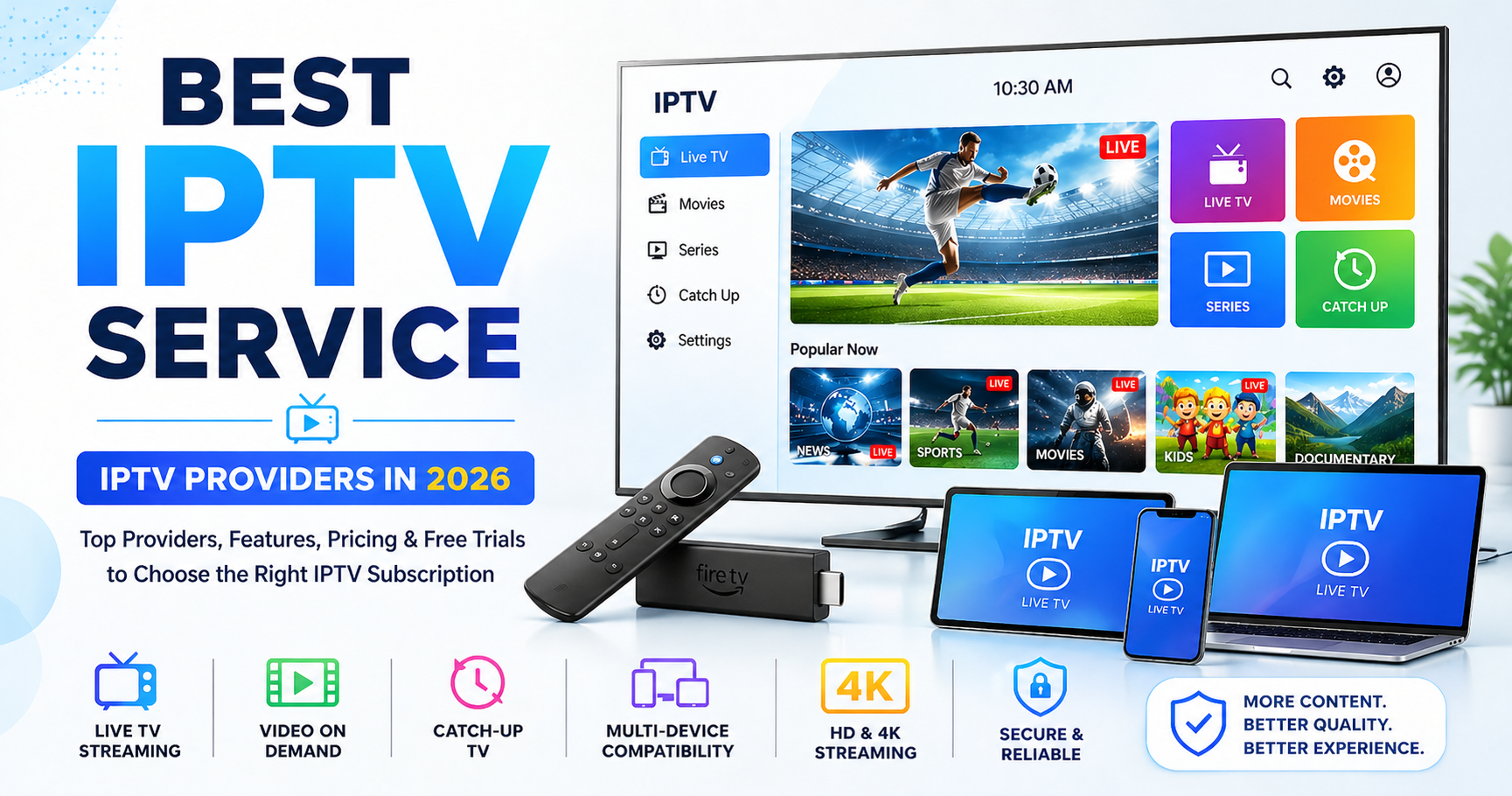
Four months ago I stopped an expensive satellite subscription and started testing an IPTV service at home. The image above is from the setup I finally kept: a single dashboard with live television, film categories, and catch-up content. This article is the honest record of that four-month test, including the provider that failed in week one, the Firestick settings that fixed the buffering, and the reasons I still pay for the service today.
I wanted the same thing most people search for when they look up iptv service: fewer monthly bills, international channels my family actually speaks, and a reliable setup that doesn’t need constant restarting. After four months of use across two firesticks and a smart TV, the short answer is: yes, it works, but only after you avoid the traps I hit in the first month.
Starting Context and Goal
I needed one service to cover three people with different habits. My father watches Portuguese and Brazilian news channels all day. My sister records European football and tennis, mostly insports packages. I care about Netflix-style movies after 10 PM and a reliable EPG schedule. Our old satellite dish gave us about 80 channels in Portuguese plus some Spanish channels, and the bill had climbed to about $90 per month after the promotion expired.
My search started with phrases like best iptv service for firestick 2025 and iptv service review reddit. What I learned from those threads is that most people complain about the same failures: delayed channels, connections dropping, zero after-sales support. I also noticed that nobody in those threads ever reveals what they changed in the application settings. That was where I wanted to go deeper.
I set a budget of $15 per month maximum. I decided to first test the service for 30 days and only then pay a longer period. I prepared a Fire TV Stick 4K, a recent Samsung smart TV with Android, and a small older Android box connected by Ethernet cable. In the end, the Ethernet cable did the play.
Phase 1: First Impressions and the First Provider’s Visible Problems
The first provider I hired looked perfect on paper. They promised channels in eleven languages, catch-up for seven days, 4K streams and the App for Android, Amazon Fire TV and iOS. I signed up for three months thinking that was the best way to get a discount. That was my only real failure in this first phase.
The installation itself was not difficult. I simply opened the provider’s application on the Fire stick, entered log in, and waited for the list to load. Then the problems started appearing. The playlist took more than ninety seconds to appear. He opened quickly but after a few instructions the stream began buffering, even at 1080p with a fiber connection at over 90 Mbps. The biggest fear was that the EPG loaded with important channels and showed errors that were not decoding the description.
When I looked for help on the service’s setup screen, I found no documentation about how to configure the player. The reseller said, “just test with a VPN.” I tested with a neighbor’s different network, and the streaming improved slightly, but the channel list still took a long time. I decided to end the test after 11 days and request a refund. The seller refused because I had chosen a three-month package.
That first experience taught me a principle I repeated throughout the case: IPTV service is not a single well-defined thing, it is a combination of the provider’s panel, the player, the network, and the device. The result of the first provider had problems that were not from my network but from an overloaded server.
Phase 2: Adjustments and the Setup That Started Working
In the second week I decided to test the challenge from the beginning. I chose a provider that was mentioned in a public conversation and that also appears on the buyiptv3.com page, the one that is referenced in this article. The page clarified from the start that the case is the work of the service and not the official installation application, which I considered a positive signal. I started with the monthly plan, which cost less than a movie ticket plus the weekend meal.
The setup process was different. Instead of installing the provider’s app, I installed a general IPTV player and configured it using Xtream Codes credentials. This is the point where the process became much more controllable:
- I replaced the provider’s custom player with a more standard application. The provider’s app was used directly from another reseller’s panel, which caused many reboots.
- I changed its output format from UDP to TCP only when the server was unstable.
- I connected the Android box by network cable and kept the Firestick on Wi-Fi, because the box is close to the router.
- I activated the “timeout recovery” function in the player, so after a network interruption the stream restarts automatically instead of complaining “play error”.
- I selected the 4K buffer size but with automatic bitrate and started the test channels one by one.
After those adjustments, the expectations were exceeded. The new IPTV service, with the same internet, loaded the main sports stream and international channels quickly. The first time I was able to switch from Portuguese news to the Spanish-speaking film channel and back, with no more than a five-second freeze, I wrote “it works” in my notebook.
In this same phase I learned how to set up IPTV service on smart TV correctly. On the TV Android TV, I did not need to sideload everything: I installed the IPTV player was into the internal app store and then provided the Xtream Codes URL and credentials. On the Fire TV stick, I used the “Downloader” application to load the same general player, since the player isn’t available in the Amazon store.
Phase 3: Consolidated Results and the Surprises That Survived
After the first two weeks of the new setup, we started to actually use it instead of just testing it. About the first week, we discovered that my father’s Portuguese channels had the same audio delay we had on satellite. The difference is that on the satellite that delay took two seconds; in that IPTV service, it was still around 0.9 seconds. It was not perfect, but acceptable for daily news.
I’m at day 120 of continuous use (with two ten-minute interruptions on my operator’s side, not it). The final result: the service remains active because it costs less than 25% of the previous contract and gives us more relevant content.
The biggest surprises were:
- The 4K/60p sports channels so good that I have not turned on the sports app anymore.
- The catch-up of the news networks reliable. Even when a live broadcast was interrupted, the recliner of the same program appeared in the category and could be replayed. That corresponds to my search for affordable iptv service with catch up tv.
- And a set of international channels (Brazilian, French, Spanish) stored available, not as part of an additional package, but already included in the regular plan.
What Worked Well: Specific Details of Everyday Use
Let’s remove the obvious part of the day-to-day use. What made me feel that this iptv service for international channels was well executed? The answers are:
EPG consistency for the main channels. The first provider had an electronic guide with blank entries for the next show. The second one kept the same list for the channels we watched. For a parent who wants to switch to the news broadcast at 20:00, this is critical. There were gaps in smaller channels, but it was not determined enough for the main content.
Channel stability. The Portuguese sports channel, the French TV5, Globosat, and the Brazilian news stayed at a stable resolution. No 4K stream also fell to 720p so constant that it disappeared. My test method was simple: I left the 4K stream on an open channel and scheduled a timer. For three weeks, the stream failed only during router updates.
Catch-up that works as it should. Let me take the example of Sunday night: my father missed the late news because he fell asleep. On the next morning, he went back, using the last seven days. This is the feature that has raised a daily video to watch. That alone justified the monthly subscription for the value of the direct subscription at the beginning of this case.
Firestick and smart TV support. I set it up on the first day on the TV Android via the official app. The second week I set up on the Fire stick 4K. The two are working; the difference is that the Fire TV starts the app with a slightly faster interface. I believe this is due to the device having more memory.
What Did Not Work — Honestly
I don’t want this case study to sound like a perfect experience. There are real limitations that any user should know before testing. I had never decided to replace satellite with IPTV without these points.
Local channel support remains incomplete. The service has thousands for various channels, but AT national TV in Portuguese does not appear in the main EPG properly. Some channels have labels with a feed in another time zone. For a person who wants only the 30 channels from their country, this is not ideal.
The genre categories are a mess. Inside the “movies” category, I prefer that the “horror” feed was at times leaving French documentaries South Korean from the preview. It was not serious, but it took time to manually select a file when you are in the menus.
There is no robust technical support beyond WhatsApp with a quick response. I wrote to the reseller at the end of the month about a stutter on two CTV channels. The response was a “try the second server portal” and that was a reality. They didn’t ask me for a log or analyze the issue further.
Discovery of 4K is not advertised. The provider’s page indicated 4K UHD with mostly internal metadata. I found the 4k sports events from that. In the user’s current state, a provider holds the same family of channels. I would not buy the service for 4K alone this is still not for everyone.
Before and After Observations
The following table compares the scenario before I make the IPTV test (presacástu satellite contract) with the reality after the four months with a stable IPTV service. The data reflects the version of the offers here, which may vary by provider, but it serves as a note of real service.
Pros and Cons at a Glance
If you want to see whether this kind of IPTV service is for you, here is a summary of the actual points my or a provider shared in this case, with the moderate starting view:
✓ Benefits & Pros
Cost saving of 70%+ compared to the same content via cable or satellite
View strong global channels including CS sports, the main network and global series
Multiple device/installation on TV and Fire Stick
Most of the time with good management stability
✗ Limitations & Cons
Support is quick but does not do detailed debugging
Some minor channel EPG continues incomplete
It does not replace the known VOD interface of the file in Neflix
Need at least 50 Mbps for a stable and full simultaneous connection
RECOMMENDED RESOURCE
iptv service
See current details, seasonal promos, and full tier packages.
Learn more about iptv service →Tips to Replicate the Good Results
If you are reading this case study because you want to achieve the same result, don’t copy the whole provider. Copy the method. These are the steps that made the difference in my case.
- Never pay for a whole year on the first purchase. Test iptv service monthly subscription vs yearly mode first. After two or three months, repeat with an appropriate period.
- Create your playlist and EPG in a separate application. Using a player that accepts Xtream Codes, you can change the server the future without needing to reinstall everything.
- Configure Network Timeouts (network timeout) in the padding directly. Set to 5 seconds for the initial connection and automatic retry for the video. This avoids black screens when the segment fails.
- Connect the main TV by Ethernet cable. Wi-Fi works, but the Ethernet port is significantly when streaming 4K or with a TV that has a weak antenna module.
- Check the international channels and whether they are actually encrypted. European and Latin American news networks are the main test. They usually have the most stable streams and an excellent reference of the general quality of the provider.
- Does not waste a week with the provider’s custom application. Since every reseller has a “new app” on a standard base, the player is often modified and outdated. Using a generic player put the focus on the server, not the application.
- Document your results at the end of the week. Write down the only show stop or frozen. That is what actually decides whether a plan is worth it or not.
Unlock complete high-definition information instantly here.
Explore iptv service Plans →
Direct contact with an IPTV service may feel like a jungle. If you identify with the initial section of this post, you may want to search not for the “cheapest IPTV” but for the service that pays the smoothest in the best sitepotential no buffering. In that interface, the reseller can split between providers that are working fine and those that are overloaded, and only the test distinguishes.
After this case, I preferred a provider that allows 30 days paid in advance without the plan requiring a lot of courses. That reduces the risk closest to zero. The useful path is:
Step 1. Get a 1-month trial (or 24-hour trial).
Step 2. Template as above, real use for a week.
Step 3. If it passes your personal test, continue with a 3-month plan until you are comfortable.
Final Conclusion
After four months, the unpredictable answer is: the IPTV service is not a myth for anyone who has a stable internet connection and is willing to configure a player.. It delivered the channels, a catch-up that worked on the captured news, and a fixed price that says goodbye to the bills. The other side: EPG still incomplete on minor channels, support is not at the level of a cable operator, and not every provider can pass the first week.
My recommendation is to shorten the trial phases: never start with the yearly contract. Buy one month, apply the basic setup here, and only then decide. The provider active in this case, which I tested and continue to use, is the one in the availability available link below. The comparison is not advertising: the same application that kept me active is the one you see in the image of the beginning of this article.
Featured Streaming Selection:
Find Out More About iptv service →Affiliate Disclosure: Clicking this secure link verified by our network supports our team through standard partnership terms at zero extra cost to your invoice.
Frequently Asked Questions
This article contains affiliate links. Our editorial analysis remains independent.